

Urban Design and Student Health
Urban Design and Student Health
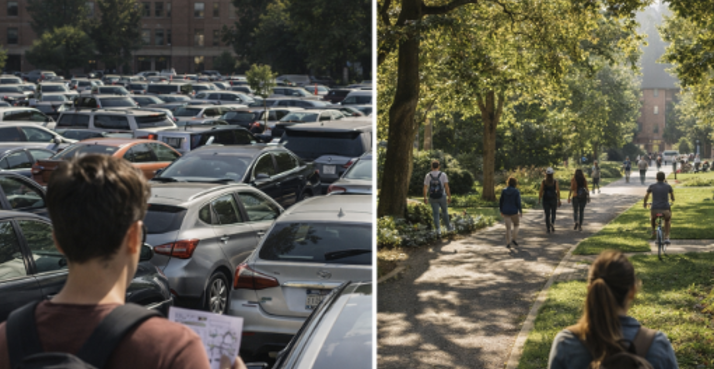
Have you ever noticed that you feel significantly more stressed when you have to navigate a massive parking lot compared to walking through a tree-lined path? That is not an accident. The way our campuses and cities are designed has a direct impact on our cortisol levels and our overall sense of community. For many students in car-dependent areas, “going to class” involves a stressful commute and a hunt for a parking spot, which immediately puts the brain into a state of frustration before the first lecture even starts.
Urban design is essentially a form of “silent psychology.” Walkable campuses with plenty of green space and “human-scale” buildings encourage spontaneous social interactions and physical activity. In contrast, “sprawl” design isolates us in metal boxes and forces us to spend our time in transit rather than in conversation. When a campus is built around cars instead of people, it sends a message that efficiency and throughput are more important than human well-being. We end up feeling like we are just moving through a system rather than living in a neighborhood.
We should be advocating for more “people-first” infrastructure. This means better bike lanes, more reliable public transit, and the preservation of natural spaces where we can sit and breathe without hearing traffic. As we look toward our post-graduation lives, the walkability of a city should be just as important as the job market or the cost of rent. A well-designed environment does half the work of maintaining your mental health for you. We deserve to live in spaces that were built for our feet and our minds, not just for our engines.
T. Lam